

- 00Days
- 00Hours
- 00Minutes
FRIENDSHIP COMPATIBILITY SCORE
Decode the Energy Between You

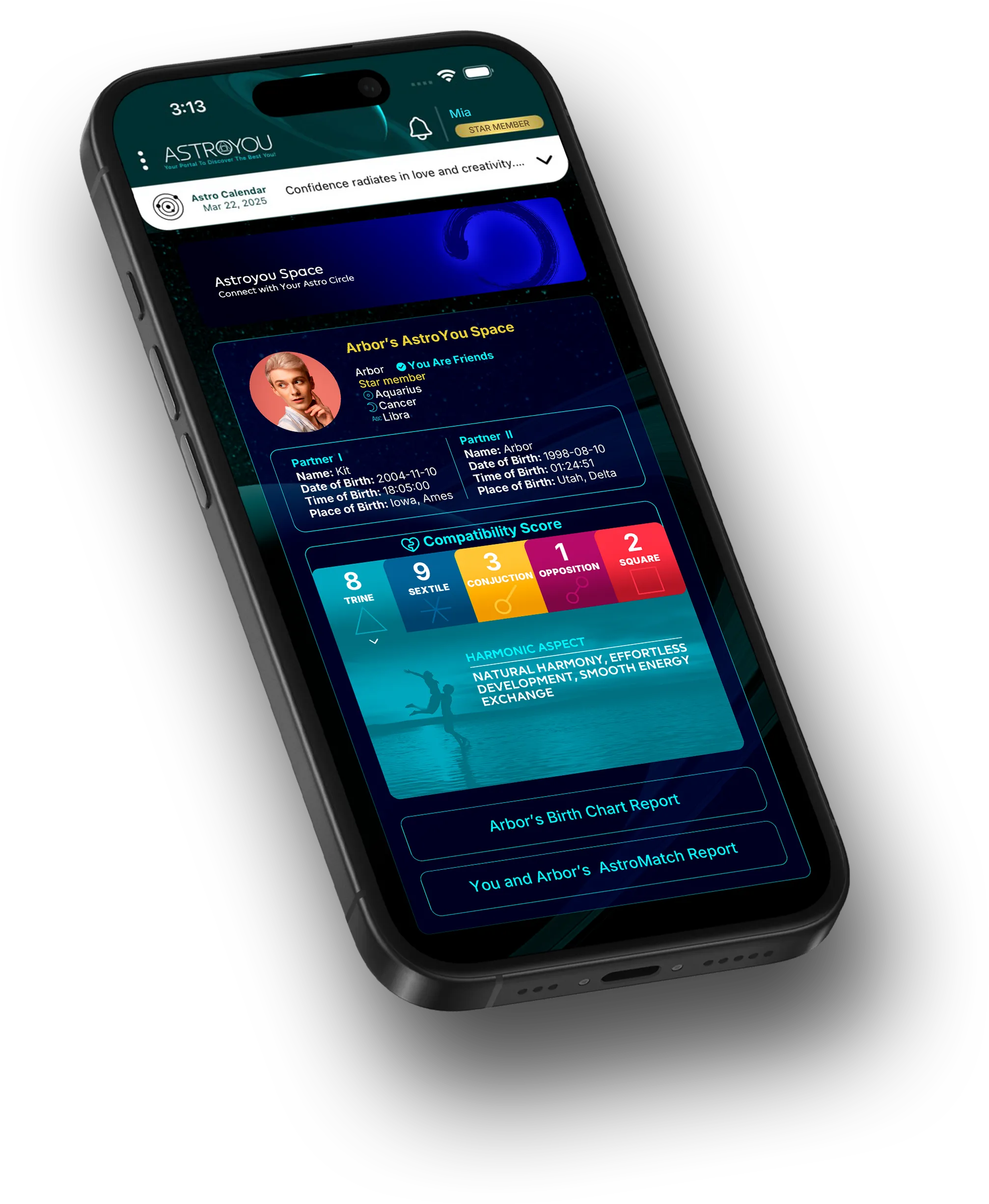

AstroYou App: Get Exclusive Early Access to the Future of Astrology!


First 369 sign-ups receive a FREE AstroMatch Report $40 value
Friendship is more than just shared interests—it’s about energy alignment. Astrology reveals why some friendships feel natural and supportive while others require more effort. Your friendship compatibility score is based on your birth chart, highlighting key aspects that shape your bond with others.
Each person has a unique astrological signature that influences how they connect with friends. Moon aspects plays a major role in emotional understanding while Mercury aspects determine communication styles. If your Moon shapes harmonious aspect with a friend’s moon, emotional trust and support come easily. But if Mercury hard aspects clash, misunderstandings may arise.
Another factor is Venus aspects, which governs the way we express affection. Friends with harmonious Venus aspects often enjoy similar activities and social dynamics. For example, if two people have Venus trine Moon, they naturally understand each other’s emotions. But a square aspect might indicate a friendship that requires mutual understandin.
Astrology helps you recognize and appreciate the unique qualities in your friendships. Calculate your friendship compatibility score today and discover which friends align with your cosmic energy!
Discover Your Cosmic Blueprint with ASTROYOU.
Unlock the wisdom of the stars and gain deep insight into your life, relationships, and destiny. ASTROYOU offers free birth chart reports, love compatibility insights, personalized daily astrology, and a comprehensive celestial calendar—all designed to help you navigate life’s journey with clarity and purpose. Join now to explore astrology like never before!
© 2025 AstroYou. All Rights Reserved. AstroYou® is a registered trademark of Smart Ocular Studio LLC.
**Friendship Compatibility Score: A Measure of Connection**
Friendship is an intricate tapestry woven from shared experiences, values, and mutual understanding. The essence of a strong friendship often lies in the compatibility between individuals, which can significantly influence the depth and longevity of their connection. In recent years, the concept of a “Friendship Compatibility Score” has emerged as a fascinating tool to assess the dynamics of interpersonal relationships. This essay seeks to explore the significance of such a score, the factors that contribute to friendship compatibility, and its potential implications.
The foundation of a Friendship Compatibility Score rests on the recognition that not all friendships are created equal. While some relationships thrive effortlessly, others may be fraught with misunderstandings and discord. The evaluation of compatibility takes into account various dimensions, including shared interests, personality traits, communication styles, and values. Utilizing a compatibility score can effectively illuminate the strengths and weaknesses within the relationship, providing insights that may not be immediately apparent to the individuals involved.
One of the primary components of friendship compatibility is the alignment of interests. Friends who engage in activities they both enjoy—such as sports, hobbies, or cultural pursuits—are more likely to experience fulfilling interactions. The presence of common interests fosters a sense of belonging and companionship, allowing friends to create shared memories and experiences. Conversely, a significant disparity in interests may pose challenges, leading to feelings of disconnection or alienation.
Equally important are the personality traits of the individuals involved. Theories in psychology often emphasize the significance of personality compatibility in forming lasting relationships. For instance, extroverted individuals may find it challenging to connect with those who are introverted, as their social needs and preferences differ markedly. A Friendship Compatibility Score can quantify these differences, offering a clearer understanding of the interpersonal dynamics at play. This quantification not only aids in self-reflection but also encourages individuals to cultivate an appreciation for diverse personalities within their social circles.
Moreover, communication styles play a critical role in establishing and nurturing friendships. Effective communication fosters intimacy and trust—a cornerstone of any successful relationship. A Friendship Compatibility Score can evaluate how well friends articulate their thoughts, listen to one another, and resolve conflicts. When communication styles align, friends are more likely to navigate challenges with ease and foster a sense of safety in their interactions. Conversely, misaligned communication styles can lead to misunderstandings, fragmentation, and, ultimately, the deterioration of the friendship.
Values, too, constitute an essential element in assessing friendship compatibility. Friends often gravitate towards one another based on shared beliefs and moral frameworks. Whether these values relate to social issues, personal ambitions, or life philosophies, their alignment can create a profound bond. A Friendship Compatibility Score that emphasizes value congruence can illuminate the core principles that underpin a relationship, highlighting areas of synergy as well as potential conflict.
In conclusion, the concept of a Friendship Compatibility Score serves as a valuable lens through which one can evaluate and enhance interpersonal connections. By analyzing shared interests, personality traits, communication styles, and values, individuals can gain insights into their friendships that may facilitate greater understanding and growth. While no score can encapsulate the entirety of human connection, it offers a structured approach to examining the complexities of relationships. Ultimately, the pursuit of compatibility fosters a deeper appreciation of the varied tapestry of friendship, promoting connections that are not only enjoyable but also meaningful and enduring.